Astronomers find a giant hidden planet inside one of the most closely studied planetary systems
A bright disk of cosmic dust had concealed the world from view, and its discovery is prompting a rethink of how planets form in systems long assumed to be fully mapped.
By Source Reporters Newsdesk
Fri, 24 July 2026 · 3 min read
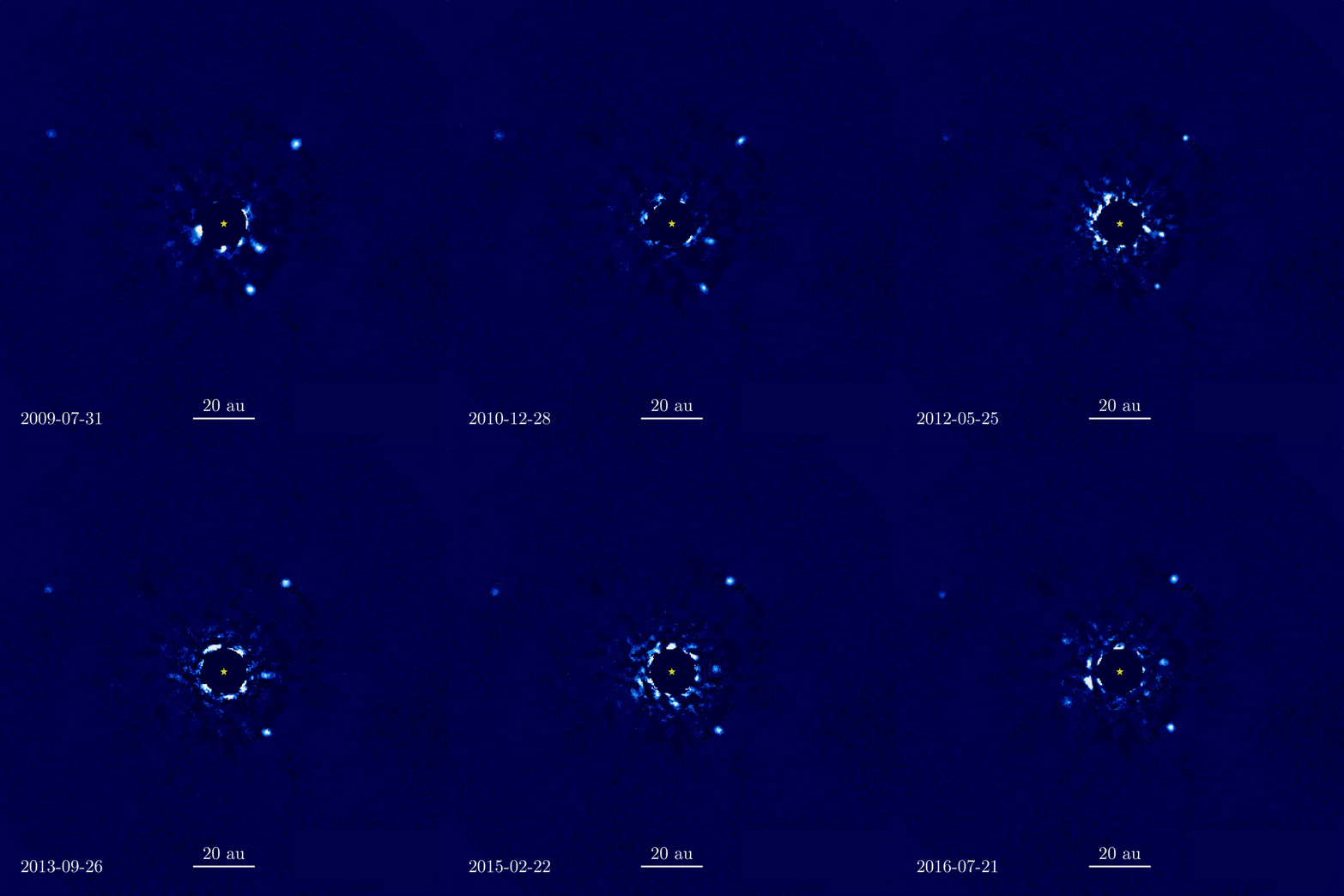
Astronomers have discovered a giant planet hidden inside one of the most intensively studied planetary systems in the sky, concealed for years behind a bright disk of cosmic dust that obscured it from earlier observations.
The system has been a frequent target of telescopes for years precisely because its dust disk — the swirling ring of gas and debris left over from planet formation — is unusually bright and well-resolved, making it a favorite subject for astronomers studying how planets take shape around young stars. That same brightness, researchers say, is likely what allowed the newly identified planet to escape detection for so long: its light and gravitational signature were effectively masked by the glow and structure of the disk itself.
The discovery was made possible by advances in high-contrast imaging and modeling techniques that let astronomers distinguish the faint signal of a planet from the much brighter surrounding disk material — a persistent challenge in exoplanet science, since planets are enormously dim compared with the stars and disks they orbit. Researchers say the find underscores how much may still be hiding in plain sight even within systems that have already been mapped in detail, and it raises the possibility that other well-studied disks could be concealing planets of their own.
Because the system had already been closely observed, the new planet's discovery gives astronomers an unusually rich existing dataset to work with as they characterize its properties, including estimates of its mass, orbital distance, and likely role in shaping the surrounding disk. Giant planets are thought to carve gaps and rings into the dust disks they form within, structures that have themselves been used for years as indirect evidence of unseen planets — a hypothesis this discovery helps confirm directly.
The finding adds to a broader run of exoplanet science in recent years demonstrating that even the best-known nearby systems can still yield surprises as imaging technology improves. It also feeds into ongoing debate among planetary scientists about how giant planets form — whether primarily through the gradual accumulation of a rocky core that then pulls in surrounding gas, or through the more rapid gravitational collapse of unstable regions within a disk. Directly observing a young giant planet still embedded in its natal disk gives researchers a rare opportunity to test those competing models against real data rather than simulations alone.
Follow-up observations are expected to refine estimates of the planet's mass and composition, and to search for any smaller companion planets that might also be hidden within the disk's structure. Researchers say systems like this one — bright, well-mapped, and now known to contain at least one hidden giant — are likely to become priority targets for the next generation of space and ground-based telescopes specifically designed to hunt for planets embedded in dusty, disk-obscured environments.
The result is also expected to inform target selection for upcoming direct-imaging missions, which are designed to photograph planets around other stars directly rather than inferring their presence from indirect effects — a technique that depends heavily on knowing where, and how, planets tend to hide.
Source Reporters corrects errors promptly. Spotted something wrong? Tell us — read our editorial standards and corrections policy.