High-resolution maps expose how fragmented Europe's wetlands have become
A machine-learning sweep of satellite imagery has produced the most detailed maps yet of Europe's wetlands — and a stark picture of fragmentation and loss.
By Source Reporters Newsdesk
Mon, 20 July 2026 · 1 min read
A machine-learning analysis of satellite imagery has produced the most detailed maps yet of Europe's wetlands, revealing a landscape that is heavily fragmented and unevenly in need of restoration, researchers report in *Nature* ( The work is summarised in a *Nature* News & Views article published on 20 July (
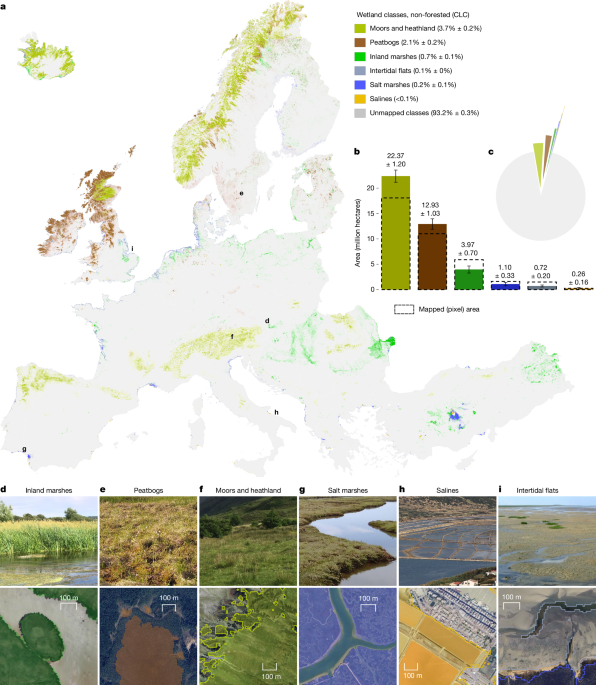
Kovács et al. mapped six natural and semi-natural open wetland types — including inland marshes, peatbogs, salt marshes, salines, intertidal flats and moors and heathland — at 10-metre resolution across 38 European countries for a 2018 baseline. The model, an XGBoost algorithm trained on 101,000 reference points and fed more than 470,000 Sentinel-1 and Sentinel-2 radar and optical scenes, achieved an overall accuracy of 96.6%.
The maps show about 413,500 square kilometres of such wetlands — roughly 6.8% of the land surveyed. That matters because, although wetlands cover only 5–8% of Earth's land surface, they hold 20–30% of the planet's soil carbon, an estimated 2,800–4,300 billion tonnes of CO2, and play an outsized role in climate regulation, the authors note.
Europe is a global hotspot of wetland loss: average extent has fallen by more than 50% since 1700 and by over 75% in several countries, mainly through drainage for agriculture and forestry. Against that backdrop, the EU Nature Restoration Regulation (Regulation (EU) 2024/1991) requires degraded ecosystems to be restored to 30% by 2030, 60% by 2040 and 90% by 2050.
The researchers argue that meeting those targets demands high-resolution, standardized and regularly updated mapping of wetland extent, type and disturbance — exactly what their dataset provides — to guide the regulation's Article 4 restoration measures from 2030 onward. The study concludes that Europe's remaining wetlands are highly fragmented, with restoration needs that vary sharply from country to country.
Source Reporters corrects errors promptly. Spotted something wrong? Tell us — read our editorial standards and corrections policy.